Written by Amaury de Barros Conti, Partner | Vice President Investments
WHAT MOVED MARKET LAST WEEK
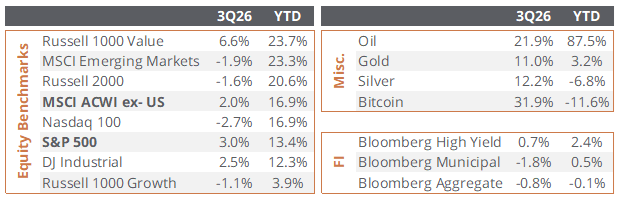
The week’s market narrative was defined by the interaction between accelerating artificial intelligence investment and renewed monetary-policy caution. U.S. equities advanced modestly as strong technology earnings outweighed a more hawkish message from the Federal Reserve. The Nasdaq gained approximately 0.9%, while the S&P 500 and Dow Jones Industrial Average each rose about 0.5%, as per Bloomberg data. Market participation remained uneven, however, with the Russell 2000 declining roughly 1.4% as rising expectations for additional monetary tightening weighed on smaller, more rate-sensitive companies.
- Technology leadership was supported by Nvidia, which reported fiscal second-quarter revenue of $96.2 billion, an increase of 106% from the prior year, and provided strong forward guidance. The results appear to reinforce the durability of AI infrastructure demand, while favorable developments at Salesforce suggested that established software platforms may also participate in the value created by AI adoption. At the same time, Alibaba’s approximately $10.2 billion equity issuance to finance data centers and cloud capacity highlighted growing investor scrutiny of the capital required to support AI expansion and whether that spending will earn an adequate return.
- Monetary policy provided the week’s principal counterweight. At Jackson Hole, Federal Reserve Chair Kevin Warsh emphasized that inflation remains above the Fed’s objective and left the possibility of further tightening on the table if price pressures do not moderate sufficiently. Markets interpreted the remarks as hawkish, contributing to a flatter yield curve and an increase in the policy-sensitive two-year Treasury yield.
- The Treasury’s increased long-maturity buybacks may influence the shape of the yield curve at the margin, but their current scale appears limited relative to the structural forces affecting long-term rates.
- Economic data remained mixed. July core PCE inflation increased 0.2% for the month and 3.3% year over year, while headline PCE reached 3.7% year over year. Durable goods orders rose 1.1%, and initial unemployment claims declined to 203,000, indicating continued economic resilience. Consumer confidence softened, however, with the University of Michigan sentiment index falling to 51.7 from 55.2 and the Conference Board’s measure also declining.
LOOKING AHEAD
- We expect that investors will focus on another active technology earnings calendar, the September 2 Beige Book, the ISM manufacturing and services surveys, and the August employment report scheduled for September 4.
- These releases should help clarify whether resilient activity and persistent inflation are sufficient to support additional monetary tightening ahead of the September 15 to 16 FOMC meeting.

Amaury de Barros Conti
Partner | Vice President Investments
Source: Bloomberg Finance (index and sector returns, rates and commodities figures); U.S. Census Bureau (durable goods orders); U.S. Department of Labor (initial jobless claims); University of Michigan Surveys of Consumers; and The Conference Board (consumer confidence). Data as of August 28, 2026.
General Disclaimer: This material is provided for informational purposes only and should not be construed as investment, legal, or tax advice. Sendero Wealth Management, LLC is an SEC-registered adviser; registration does not imply skill. References to specific securities are for informational purposes and do not constitute a recommendation to buy, sell, or hold any security. Views are as of the date noted, may change without notice, and forward-looking statements are not guarantees of future results. Data from third-party sources is believed to be reliable but is not guaranteed; indices are unmanaged and not available for direct investment. Past performance is not indicative of future results. All investments involve risk, including possible loss of principal. Consult your professional advisers regarding your specific circumstances. Review our Form ADV & Form CRS here.