
Written by Amaury de Barros Conti, Partner | Vice President Investments
WHAT MOVED MARKETS LAST WEEK
U.S. markets diverged sharply as higher-than-expected inflation, rising energy prices, and growing scrutiny of artificial intelligence investment prompted investors to rotate away from large-cap growth stocks. As per Bloomberg data, the Nasdaq Composite declined 4.48%, its fourth consecutive weekly decline, while the S&P 500 fell 1.95%. The Dow Jones Industrial Average gained 0.67%, reflecting comparatively stronger performance among value-oriented and defensive companies.
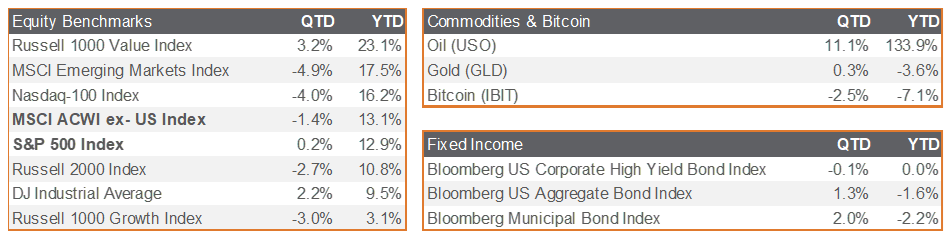
- The week highlighted an increasingly important tension for investors. Economic activity remains positive and corporate earnings are generally supportive, but oil above $100 per barrel and renewed inflation pressure are complicating the Federal Reserve’s policy outlook. At the same time, higher financing costs are causing investors to assess more closely whether the scale of AI-related capital spending will generate adequate long-term returns.
- Within equities, the rotation away from growth does not necessarily signal the end of technology leadership. It does raise the hurdle for capital-intensive companies whose valuations depend on distant cash flows or continued access to favorable financing. We believe strong balance sheets, demonstrable pricing power, disciplined capital allocation, and the ability to translate investment into free cash flow should remain valuable across both growth and value sectors.
- Treasury yields declined even though both consumer and producer inflation exceeded expectations. The 10-year Treasury yield initially rose to approximately 5.33% following the CPI report but finished the week near 5.09%, about 15 basis points below the previous Friday. The 2-year Treasury yield closed near 4.72%, while the 30-year ended near 5.43%. Demand for government bonds appeared to increase as the technology sell-off encouraged a shift toward defensive assets.
- September inflation was the week’s most important economic development. Headline CPI increased 3.7% from a year earlier, above the 3.6% consensus estimate and up from 3.4% in August. Core CPI increased 2.6% year over year. Gasoline prices rose 9.1% during the month and accounted for more than half of the monthly increase in headline CPI.
- Producer inflation was even stronger. PPI increased 1.3% in September and 6.3% from a year earlier, its largest annual increase in more than three years. Core producer prices rose 0.7% for the month, also exceeding expectations. The report points to continued pressure within corporate supply chains and raises the possibility that companies may need to absorb higher costs or pass them through to customers.
LOOKING AHEAD
- Third-quarter earnings will remain a central focus, with approximately 212 companies with market capitalizations above $2 billion expected to report. Technology and semiconductor results will be particularly important for evaluating AI spending, while reports from industrial, aerospace, consumer, communications, and transportation companies should provide broader evidence regarding final demand and margin pressure.
- The Federal Reserve has entered its communications blackout period ahead of the October 27-28 FOMC meeting. Following September’s increase to a 3.75% to 4.00% target range, futures markets indicated approximately a 17% probability of another increase in October as of Friday afternoon. The coming week’s economic calendar includes housing starts, building permits, jobless claims, flash purchasing managers’ indexes, and the final October consumer sentiment reading.

Amaury de Barros Conti
Partner | Vice President Investments
Source: Bloomberg, U.S. Bureau of Labor Statistics, CME FedWatch, FactSet, Reuters.. QTD reflects returns from Oct 1 through October 16, 2026 and YTD reflects January 1 through October 16, 2026. Commodities & Crypto returns are represented by ETFs (ticker provided above), used as proxies where the exposure is not directly investable index returns are not available. ETF returns reflect total price return with distributions reinvested and are net of each fund’s operating expenses; the index returns shown elsewhere on this page are gross of fees, so the two are not directly comparable. Data as of October 16, 2026.
General Disclaimer: This material is provided for informational purposes only and should not be construed as investment, legal, or tax advice. Sendero Wealth Management, LLC is an SEC-registered adviser; registration does not imply skill. References to specific securities are for informational purposes and do not constitute a recommendation to buy, sell, or hold any security. Views are as of the date noted, may change without notice, and forward-looking statements are not guarantees of future results. Data from third-party sources is believed to be reliable but is not guaranteed; indices are unmanaged and not available for direct investment. Past performance is not indicative of future results. All investments involve risk, including possible loss of principal. Consult your professional advisers regarding your specific circumstances. Review our Form ADV & Form CRS here.