Written by Amaury de Barros Conti, Partner | Vice President Investments
WHAT MOVED MARKETS LAST WEEK
Markets ended October with a sharp rotation beneath the major indexes. Questions about the scale and near-term returns of artificial-intelligence investment weighed on several mega-cap technology companies, while small- and mid-cap stocks advanced and value outperformed growth for a fourth consecutive week. The Federal Reserve held rates steady, but strong third-quarter growth and firmer inflation kept a December increase firmly in play.
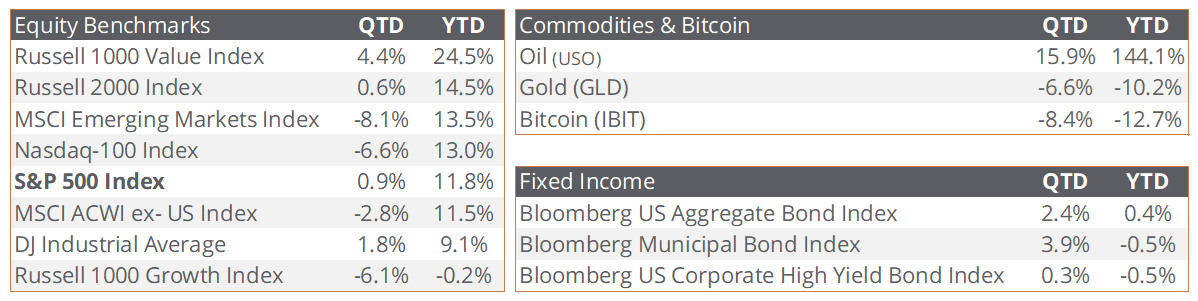
- AI spending moved from catalyst to scrutiny. Alphabet, Amazon, Intel, and several software companies sold off after results renewed questions about the timing and durability of returns on record AI-related capital expenditures. Alphabet fell around 12% for the week, while Intel declined roughly 26%. With approximately 60% of S&P 500 companies having reported, third-quarter earnings growth was tracking near 30% year over year. The earnings backdrop therefore remains strong, but the market is increasingly distinguishing between revenue growth and free-cash-flow conversion. Consensus analyst estimates compiled by Goldman Sachs Research indicate that the largest U.S. AI hyperscalers are on track to spend $800 billion in capital expenditures in 2026, making financing discipline and monetization central to the next phase of the AI investment cycle.
- Treasury yields fell even as the economy ran hot. The Federal Reserve held the federal funds target at 3.75% to 4.00% in a 10-2 vote, with two officials favoring another quarter-point increase. The two-year Treasury yield ended near 4.56% and the 10-year near 4.94%, down roughly 13 and 6 basis points for the week, respectively. Futures nevertheless placed roughly an 80% probability on a December rate increase following the stronger growth and inflation data.
- Growth remained resilient, but the consumer cushion narrowed. Real GDP expanded at a 3.4% annualized rate in the third quarter, the fastest pace in a year, led by 3.8% consumer-spending growth and strong business investment. September headline PCE inflation accelerated to 3.6% year over year and core PCE to 3.1%, both above the Fed’s 2% objective. Personal spending rose 0.5%, outpacing the 0.2% increase in income; real disposable income declined 0.3% and the saving rate fell to 3.8%, its lowest level since late 2022. The combination suggests demand is still firm, but households may have less capacity to sustain spending without stronger income gains.
- Oil rose to a six-month high amid renewed risk around the Strait of Hormuz and attacks on Saudi energy infrastructure. Gold declined to approximately $3,885 per ounce, while Bitcoin fell below $78,000.
LOOKING AHEAD
- The November 3 midterm elections will be the week’s primary policy event, with potential implications for fiscal policy, regulation, defense, health care, financials, and digital assets. Markets will also monitor whether the election outcome alters the expected path of deficits or Treasury issuance. Historically, post-election market results have varied widely, and we believe the economic and earnings backdrop has generally mattered more than the party composition of Congress.
- Labor-market data will shape the December Fed debate. Consensus expectations call for approximately 62,000 to 65,000 new payrolls in October, a 4.2% unemployment rate, and 0.3% monthly wage growth. JOLTS job openings, ISM manufacturing and services surveys, productivity, unit labor costs, and preliminary November consumer sentiment will provide additional evidence on whether demand is cooling without a material deterioration in employment.
- Earnings remain an important test of market breadth. Reports from Apple, AMD, Palantir, Shopify, Arista Networks, Qualcomm, Arm, Uber, McDonald’s, Pfizer, ConocoPhillips, Toyota, and Sony will provide insight into consumer demand, semiconductor spending, cloud infrastructure, health care, and energy profitability.

Amaury de Barros Conti
Partner | Vice President Investments
Source: IIndex returns and payroll consensus expectations, Bloomberg; earnings growth, FactSet Earnings Insight; GDP and PCE, BEA; rate probablilities, CME FedWatch. Data is provided as of October 30, 2026 unless otherwise stated. Commodities & Crypto returns are represented by ETFs (ticker provided above), used as proxies where the exposure is not directly investable index returns are not available. ETF returns reflect total price return with distributions reinvested and are net of each fund’s operating expenses; the index returns shown elsewhere on this page are gross of fees, so the two are not directly comparable. QTD reflects returns from October 1 through October 30, 2026 and YTD reflects January 1 through October 30, 2026.
General Disclaimer: This material is provided for informational purposes only and should not be construed as investment, legal, or tax advice. Sendero Wealth Management LLC is an SEC-registered adviser; registration does not imply skill. References to specific securities are for informational purposes and do not constitute a recommendation to buy, sell, or hold any security. Views are as of the date noted, may change without notice, and forward-looking statements are not guarantees of future results. Data from third-party sources is believed to be reliable but is not guaranteed; indices are unmanaged and not available for direct investment. Past performance is not indicative of future results. All investments involve risk, including possible loss of principal. Consult your professional advisers regarding your specific circumstances. Review our Form ADV & Form CRS here.